
Chronic Pain and Identity Loss: When You No Longer Recognise Yourself
On grieving a version of yourself that is still alive
There is a particular kind of loss that chronic pain brings with it that nobody prepares you for.
Not the loss of a diagnosis. Not even the loss of movement, or sleep, or certainty about the future. Those losses are real, and they matter. But there is another one, quieter and harder to name, that tends to arrive a little later.
The loss of yourself.
Not in a dramatic sense. In a slow, disorienting, daily sense. The version of you that existed before the pain arrived; the person who moved through the world with a particular ease, who knew what they liked, who showed up for people, who had a lightness to them. That person begins to feel increasingly distant. And at some point, you realise you are not sure when you last felt like them.
This is identity loss. And in my experience, it is one of the most painful and least acknowledged aspects of living with chronic pain.
We build ourselves from what we do
When someone asks who you are, you probably answer, almost automatically, with something you do.
I am a teacher. A mother. A runner. Someone who travels, who loves to cook, who meets friends on Sunday mornings and walks for hours without thinking about it.
This is not vanity or shallowness. It is simply how identity works. We build our sense of self from the things we do, the roles we hold, the ways we move through the world and relate to other people. These activities are not just hobbies or habits. They are the evidence we have gathered, over years, of who we are.
When chronic pain removes them, it does not just change your schedule. It removes the evidence.
Pain does not announce what it takes
What makes this loss so disorienting is that it rarely arrives as a single moment. It accumulates.
One by one, quietly, the things that made up your sense of self become difficult or impossible. The long walks. The travel. The yoga class you have been going to for years. The spontaneous plans. The physical ease of simply being in your body without thinking about it.
And something else disappears alongside the activities. The person you were in those moments: the lightness, the presence, the capacity to be genuinely there with other people begins to feel out of reach.
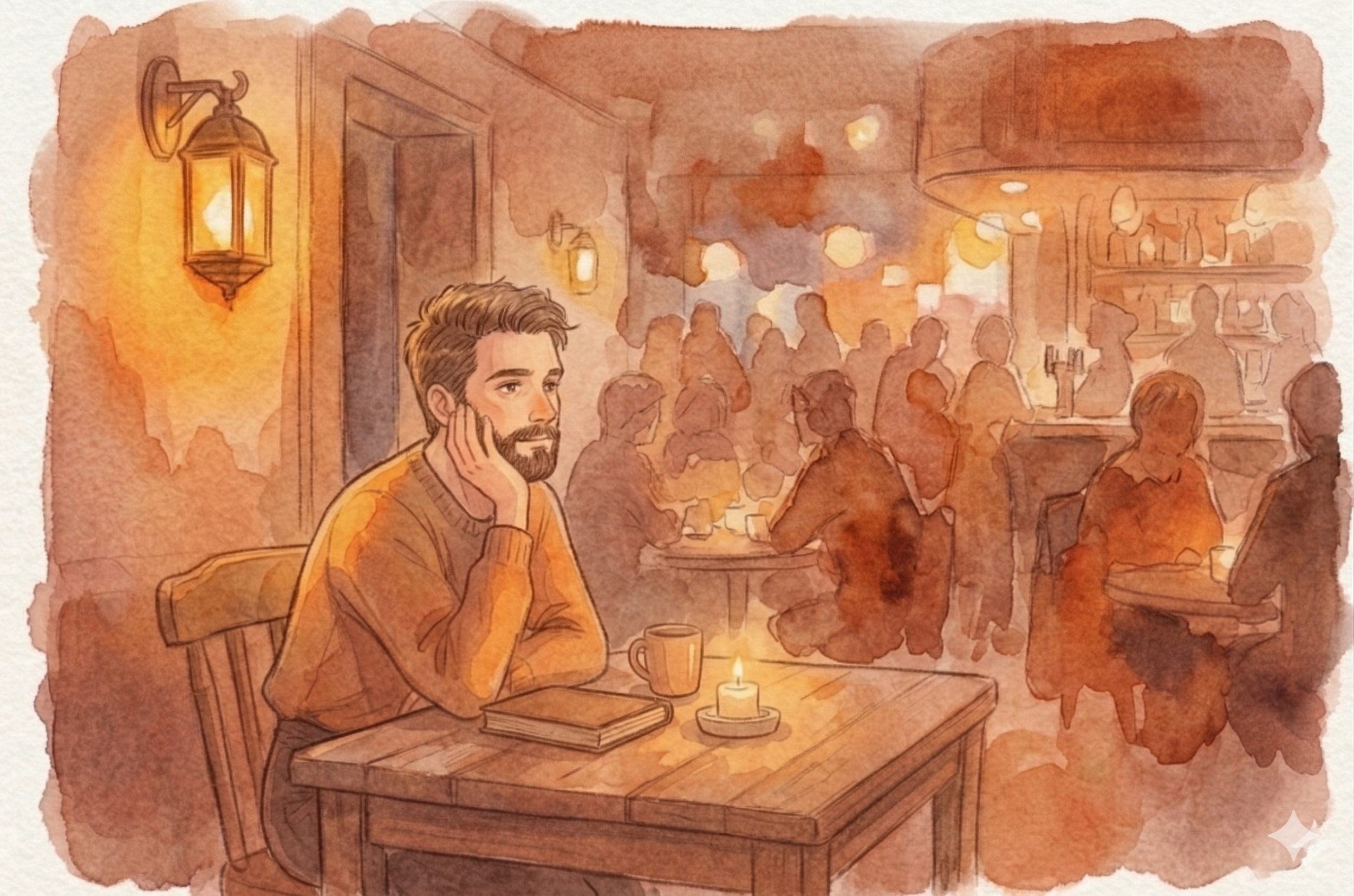
I remember this clearly from my own experience. There was a night I went to the pub with friends. I had walked there in pain. I sat in the noise and warmth of it, people I cared about all around me, conversations moving, laughter arriving.
And I could not get there.
I was smiling. I was nodding. I was performing the version of me that knew how to show up, how to be present, how to be the person others were used to. But underneath that performance, my entire attention was elsewhere. Pain was pulling it back, every few seconds, like a hand on my shoulder. I could not concentrate. I could not really hear what people were saying. I was in two places at once: the pub, and somewhere very much alone inside my body.
That was when I understood what pain had taken from me. Not the hiking. Not the travel. My presence. My ability to be genuinely, fully there with people I loved.
The story that stopped mid-sentence
Here is something that does not get said often enough: chronic pain does not just remove activities. It interrupts a narrative.
Before pain arrived, you were living a story. Not consciously but your life had a shape, a direction, a sense of forward movement. You were someone doing something, building something, becoming something. The future felt like a continuation of the self you already knew.
Pain stops that story mid-sentence.
And in the silence that follows, an uncomfortable question arrives: if I am not doing the things that made me me, then who am I?
This is not just a philosophical question. It is a visceral one. It arrives at 3am, or in a doctor's waiting room, or in the middle of a conversation you are struggling to stay present for. It does not wait for a calm moment.
The social mirror shifts
Identity is not only built internally. We also know who we are partly through how others respond to us.
And when chronic pain enters the picture, the way people respond changes.
People become careful. Concerned. They ask, every time they see you, how you are feeling. Their eyes carry something softer than usual. They mean well, and you know they mean well, but something about it lands as a kind of diminishment. Because the person they are being careful with is not the person you thought you were.
You were, perhaps, the one who looked after others. The one who showed up, who helped, who brought lightness to a room. And now the room is being gentle with you.
That role reversal is quietly devastating. Not because of anyone's behaviour. But because the mirror is showing you something unfamiliar, and you do not know yet how to look at it.
The performance of who you used to be
So many people with chronic pain describe what I would call the exhausting performance of the former self.
You still show up. You still smile. You still try to be the person others knew, because it is easier than explaining, easier than watching their concern deepen, easier than acknowledging, even to yourself, how much has changed.
But performing is not presence. And the gap between who you appear to be and who you actually are in any given moment is its own form of loneliness.
This performance costs something. It takes energy that is already scarce. And it makes genuine connection harder, because you are not actually there. You are managing the impression of being there.
Why we do not grieve it
Part of what makes identity loss so hard to sit with is that grieving it feels dangerous.
If I grieve who I was, does that mean I am accepting that I will never go back? Does it mean that this is my life now?
For some people, recovery is possible, and the story does not have to end here. For others, the path forward looks different from the one they imagined. But in either case, the grief does not mean surrender. It means acknowledgment.
You cannot write a new chapter while you are still trying to finish the old one.
Grieving the self you used to be is not giving up on recovery. It is making space for whatever comes next which may look different from what you had, and may, in time, carry its own kind of meaning.
What remains when everything else is stripped away
There is a question worth sitting with, when you are ready for it.
What makes you, you beneath the doing?
Not as a challenge. Not as an invitation to spiritual bypassing or toxic positivity. But as a genuine inquiry, offered gently: is there a version of you that the pain cannot actually reach?
Some people find, through this experience, that they know themselves more precisely than they ever did before. They know their limits. Their values. What they actually need, as opposed to what they were always providing for others. They have met their own resilience in conditions they would never have chosen.
Others are still in the middle of it, still in the gap between who they were and who they might become, and that is exactly where they need to be right now.
If that is where you are, this piece is not asking you to have found the answer yet. It is simply asking you to notice that the question exists.
And that noticing, small as it is, is not nothing.
If this resonated with you, I've created a free guide that explores all five key reasons chronic pain persists and what you can gently do about it.
📥 "5 Key Reasons Your Pain Becomes Chronic, and How to Break Free"
And if you feel the need to put your experience into words, you can also write to me via
If you're ready for personalised support on your journey, I’d love to hear from you. Feel free to reach out, and we can have a friendly chat to see if my approach is the right fit for you.
