
On the gap between what a scan can show and what pain involves.
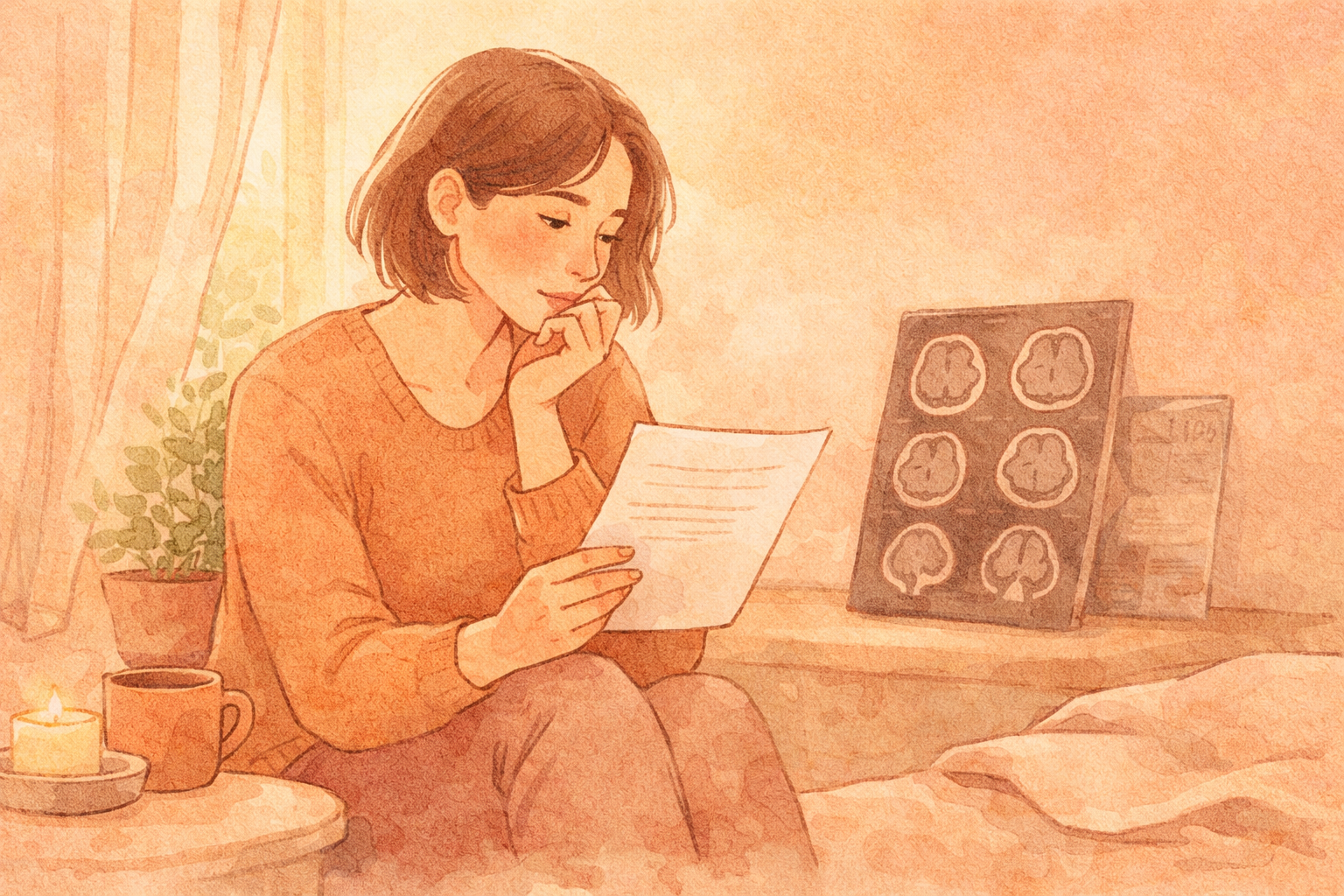
The report, and what it did not say
You have the report. You have read it, or had it explained to you, or both.
Maybe you felt a brief flicker of hope before the appointment. Maybe you told yourself: at least now I will know. At least there will be something to point to, something that explains the months of waking up braced, the days that have quietly reorganised themselves around the pain.
Then the result came back, and it said, more or less, that nothing significant had been found. Or it described something with a name, but nothing that should be causing this much trouble. You may have left the appointment still carrying what you walked in with: the pain, and now the silence around it.
If you have been in that place, I want to say something clearly first. Your pain is real. Whatever a scan shows or does not show, what you feel is a real experience, and it is not a sign that something is wrong with you as a person. That is not in question. What this post looks at is what a scan can and cannot tell us about pain. It is general information, and it is not a substitute for advice from your GP or the clinician who ordered your scan.
What scans measure, and what they do not
Imaging is a remarkable tool. It can identify fractures, tumours, infections and significant structural problems, and for those purposes it is invaluable. It was not designed to explain why a person is in pain.
A systematic review in the American Journal of Neuroradiology looked at imaging findings in people with no back pain at all. Disc degeneration was found in 37% of 20-year-olds and 96% of 80-year-olds without symptoms, and other changes such as bulges and protrusions also became more common with age (Brinjikji et al., 2015). Similar findings have been reported for the neck (Nakashima et al., 2015). These changes were present in people who had no pain.
This does not mean your findings are not real. It means that a structural finding and the experience of pain are not always linked in a simple way, and one does not reliably predict the other. Pain researchers describe pain as something the brain produces, drawing on signals from the body and also on context, past experience, meaning and how threatening a situation feels (Moseley and Butler, 2013). Your GP, physiotherapist or specialist can help you work out what a particular finding means for you.
When a word on the report becomes the wound
Some people read their scan report and feel quietly devastated, even when the radiologist considers the findings unremarkable. The language of imaging reports was not written with the reading patient in mind. Degeneration. Wear and tear. Narrowing. These are clinical terms, but they carry a story of decline, of a body that is breaking down.
Many of these findings are common in adults with no pain, as the studies above show. Words still carry meaning, though, and it can help to ask your clinician what a term means in your case and how common it is. Hearing it described in plain language can change how a report lands.
"But the pain is right where they found something"
This is an understandable conclusion. If your lower back hurts and the scan shows a bulge nearby, the closeness feels like proof. The difficulty is that the same findings appear in many people without pain, so being in the same place does not always mean one is causing the other. Sometimes they may be connected, and sometimes they may not. A clinician who has examined you is the right person to help you weigh it up.
"Something changed after the accident"
For some people the question is about a specific moment: a fall, an accident, a procedure, after which the pain began. Before, no pain. After, pain. The sequence feels like evidence, and the event was real.
Pain science also describes how, after an injury, the nervous system can stay protective for longer than the tissue needs. Alan Gordon and Alon Ziv describe this idea in The Way Out (2021). It is one way of understanding why pain can outlast an injury. It is an explanation some people find helpful, and it does not replace a proper assessment of your own situation.
When many professionals each add a piece
Over months or years, many people see several practitioners: physiotherapists, osteopaths, chiropractors, sports therapists. Each may offer an observation, such as a pelvic tilt, weak glutes or a compensation somewhere else, and each may be accurate. Over time the pieces can join up into a structural story: this caused that, which caused this.
Such stories can feel convincing because professionals helped to build them. It may also be worth knowing that pain which moves or changes location is something pain researchers have linked with a more sensitive nervous system as well as with structure (Moseley, 2007). That does not mean anyone was wrong, and I cannot tell you which explanation applies to you. A clinician who knows your history can.
If it is not only physical, is something wrong with me?
When a scan shows little, or when someone meets the idea that the nervous system may play a part in pain, the mind can leap to a painful conclusion: if it is not in my body, it must be in my head, and so I must be weak, anxious or too sensitive.
Please hear this clearly. Pain that involves the nervous system is not imagined. It is not a sign of fragility, and it is not a character flaw. Research on fear and avoidance has described for decades how normal it is for a nervous system exposed to persistent pain to become watchful, scanning for threat and bracing (Vlaeyen and Linton, 2000). That is adaptation, not weakness. The NICE guideline on chronic primary pain (NG193) includes psychological approaches among its recommendations, alongside other options, which reflects how many professionals now see pain as having physical, psychological and social dimensions.
Where this leaves you
None of this means your experience is simple, or that understanding it will change how you feel. It is one way of looking at pain, and other explanations exist. For some people, learning that a normal scan does not make their pain imaginary is a relief in itself. If you would like to talk through your options, your GP is a good place to start, and you are welcome to get in touch with me if you would like to know how I work.
References
Brinjikji, W. et al. (2015). Systematic literature review of imaging features of spinal degeneration in asymptomatic populations. American Journal of Neuroradiology, 36(4), 811 to 816.
Gordon, A. and Ziv, A. (2021). The Way Out. Vermilion.
Moseley, G.L. (2007). Reconceptualising pain according to modern pain science. Physical Therapy Reviews, 12(3), 169 to 178.
Moseley, G.L. and Butler, D.S. (2013). Explain Pain. Noigroup Publications.
Nakashima, H. et al. (2015). Abnormal findings on magnetic resonance images of the cervical spines in 1211 asymptomatic subjects. Spine, 40(6), 392 to 398.
NICE (2021). Chronic pain (primary and secondary) in over 16s: assessment of all chronic pain and management of chronic primary pain. NICE guideline NG193.
Vlaeyen, J.W.S. and Linton, S.J. (2000). Fear-avoidance and its consequences in chronic musculoskeletal pain: a state of the art. Pain, 85(3), 317 to 332.
If this resonated with you, you are welcome to download my free guide, "Understanding Your Pain Differently", which shares five ideas about how the nervous system can shape pain.
If you would like to know more about how I work, you are welcome to get in touch. A short introductory call is a chance to ask questions. It is not a therapy session or an assessment.
A gentle note
What I share here is general information. It does not replace medical advice or therapy, and reading it does not create a therapist-client relationship. If your pain is new, changing or worrying you, please speak to your GP.
